




- Details
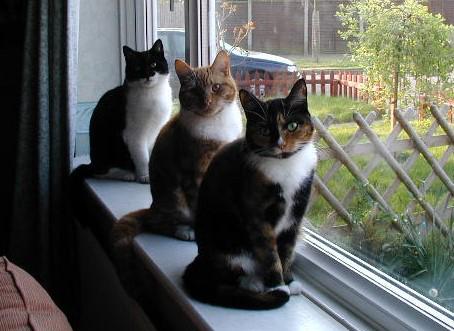
When Sue and John Redhead retired to Spain 22 years ago little did they realise how much the street cats of Fuente de Piedra would consume their lives. It all started when Sue opened a tin of pilchards for a starving cat who appeared on her doorstep one day. The cat returned and a few weeks later chose her garden as a safe place to have her kittens.
Sue has been caring for the street cats who live near her home ever since, pursuing the practice of trap, neuter and replace with the aim of controlling the number of feral cats and ensuring that the local feline population was healthy. In the winter they found a warm, dry shelter in her garage until spring when they departed on their own adventures, returning to the garden for food and water as necessary.
One rather attractive tortoiseshell, named Inca, lived in Sue’s garden for years, never stepping over the threshold until the last of the house cats had gone. Only then did she move inside to enjoy the remainder of her 17 years in domestic bliss.
Sue’s kind heart meant that many kittens and sick cats were taken into the house and stayed. The most she ever had in the house at one time was 22. Tiny kittens like Jenny the white cat, cold, hungry and vulnerable, were lovingly hand-reared by Sue, ably assisted for many years by Freeway the canine gentle giant. When a startled cat jumped out of the engine of Paul and Vanessa’s car, leaving behind her two new-born kittens, Sue bottle-fed these tiny balls of fluff until they were big enough to move to their forever home. Now 14 years old these handsome senior cats still live with Paul and Vanessa.
It has been a long journey with many heartbreaks along the way: parvovirus, a vicious dog attack and a never-ending supply of newly abandoned kittens. While Sue has at times faced disapproval and outright hostility from some quarters, she has also found a great deal of support in the community. She has had the satisfaction of seeing her fur babies grow and thrive and in return she has received their trust.
Over the last 20 years attitudes have slowly changed in Spain and new animal welfare laws have been introduced. Eventually the town hall recognised Sue’s work and provided much needed assistance. Requests for access to the abandoned building by the station to provide a warm, dry, clean and safe shelter for the feral cats of the village were eventually granted. With support from Juan at the town hall and the help of her long-suffering husband John, her friend and co-worker Carol and her husband, a wonderful shelter has been created. There are enclosures for tiny kittens that have not yet been vaccinated and neutered, enclosures and cages for sick animals who need quiet and rest. There are enough beds and cat houses, chairs and cushions for all the cats who have made the colony their home.
Sue and Carol arrive at the colony at 7am every day and work for two hours or more. All the cages are cleaned and disinfected, bedding changed and bowls cleaned and disinfected. While the cats are eating Sue and Carol check them for signs of injury or illness and medicine is given to cats who need it. When they finish at the colony, there is still all the dirty bedding to wash and trips to be made to the vet. Sue and Carol are back at the shelter about 4.30 and the whole process is repeated.
The shelter they have created is a place of calm. Cats are clean, healthy, well-fed, relaxed and happy, as testified by their shiny coats and bright eyes. There are toys and enrichment activities for the little ones, as well as lots of love and cuddles.
The purpose of the shelter is to provide a safe environment for the local colony. Since the adult cats are all neutered the colony should not have kittens. When a feral cat outside the colony has kittens on the street, Sue and her team trap and neuter the mother cat and the kittens; eventually the family is returned to the site it was taken from. The shelter does not exist to take in unwanted kittens, yet the colony has had more kittens than ever this year; over 50 of them. They are all gorgeous and many have found loving forever homes, but the rest will live their lives in the colony.
Now after 22 years Sue is retiring at the end of September and Carol is retiring with her. In Sue’s words the colony is being returned to the people of Fuente de Piedra. The existence of this wonderful shelter is due to Sue’s persistence and her love of cats. She modestly says the colony is a tribute to the people of Fuente de Piedra and the village should be proud of what it has created.
It is up to the people of Fuente de Piedra, to Juan and his team of volunteers, to the supporters who bring food and to all who love animals to continue the good work.
- Details
When the daytime temperatures are so high you are compelled to stay inside with the blinds down all day it is wonderful to be able to enjoy top class entertainment outside at night. On Saturday 18th July we attended the Antequera Light Festival.
The theme of this year’s show was the tenth anniversary of Antequera’s dolmens achieving UNESCO World Heritage status; putting them on a level with the Pyramids, Angkor Wat, and Stonehenge.
Shows took place at five locations in the town culminating inside the Royal Collegiate Church at the top of the town. As we had arrived a little early we decided to start at the end and work backwards. When we reached the viewpoint in front of the Arco de los Gigantes we were treated to nature’s own contribution in the form of a spectacular sunset silhouetting the town’s church towers.
Inside the church Antequera’s history was presented by projecting walls of massive stone blocks, marble columns and Roman artwork with particular focus on the famous efebo statue, intricate Moorish tiles and medieval wall paintings onto the building’s own architecture. With background music and commentary, it was a massive sensory overload, typical of the high-class immersive shows we happily pay pounds or Euros to visit.
After walking down the steps of the Cuesta San Judas, dappled with blue light, we returned to San Sebastián Square, where we enjoyed, with our hearts in our mouths at times, a magnificent display with fire sticks and a fire wheel.
Inside the town hall courtyard huge, coloured globes representing the sun and planets were suspended above our heads. A band performed in front of a large screen flashing up images of World Heritage Sites, like one of those lists that come round on social media where you tick off the ones you’ve been to. Antequera Dolmens tick!
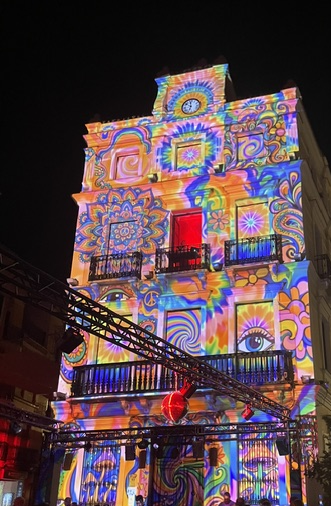
Finally, back at the beginning, San Luis Square, a DJ high up in the window of a building played music to the crowd below while the building itself was illuminated in a succession of bright patterns, like a giant kaleidoscope.
What a fantastic way to spend an evening.
- Details
Arrival of the stork
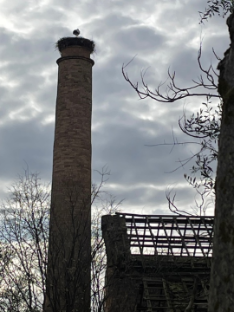
The brick chimney standing among the derelict buildings by the station is once again occupied by a stork. A familiar sight in many parts of Spain, the white stork is a familiar feature of the Bobadilla to Algeciras railway (Mr Henderson’s Railway), their nests occupying every tall pillar, chimney and pylon along the route. When they take to the air, with their huge wingspan, they are reminiscent of a scene from Jurassic Park. But here in Fuente de Piedra we have just one pair and they have been returning to the same chimney for several years. I saw them last in May when they appeared to still have young on the nest. They were absent throughout the summer and early autumn. Storks usually migrate to Africa and sometimes even as far as India at the end of the breeding season and return in the spring, but many are now remaining in Spain throughout the year to feast off landfill. Males return first to check-out the nest, with the females arriving about a month later. As we spotted him in his lonely vigil in mid-December, the female should have arrived by now and their bill clattering should once again be resounding through the station area.
- Details